

Sutewakamaru LS T-Shirt
Black / S
$34.99
Sale price
$34.99
Regular price
Skip to product information





Sutewakamaru LS T-Shirt
$34.99
Sale price
$34.99
Regular price
Taxes included.
Shipping calculated at checkout.
Size Chart

Made-to-Order
in the USA

Secure
Checkout
Product Details
- Premium Long Sleeve Graphic Tee
- Mediumweight Cotton (6.0 oz/yd²)
- Classic Fit with Rib Cuffs and Double-needle Bottom Hem.
- Vivid Print Remastered from an Original Japanese Masterwork
Fabric & Care
Premium Long Sleeve T-Shirt
- Classic fit / Crew neck / Rib collar.
- Rib cuffs and double-needle bottom hem.
- Mediumweight: 6.0 oz/yd² / 203 g/m².
- OEKO-TEX certified low-impact dyes.
- DTG print with water-based NeoPigment inks.
Made with 100% Ring-spun Cotton
- "Sport Grey": 90% cotton / 10% polyester
- "Dark Heather": 50% cotton / 50% polyester
- All other styles: 100% cotton
Take Care of your Purchase
- Machine wash cold with like colours (max 30C / 90F).
- Do not bleach.
- Do not tumble dry.
- Do not dry clean.
- Do not iron.
- Line dry in shade.
- To minimize fading of the image, wash it inside out, in cold water, and avoid excessive washing.
Shipping & Returns
In an effort to maximise our design range, avoid over-production and waste, and offer you a competitive price, all of our products are made to order.
We ship worldwide with the best courier for your location.
Delivery time estimates shown below include production (2–4 business days) and standard shipping. Most packages arrive sooner than estimated.
- United States: 6-10 business days
- Rest of the World: 12-30 business days
Due to the custom nature of our items, we cannot accept returns or exchanges for wrong size, colour, or change of mind, however if your item arrives damaged or contains an error we will gladly replace it.
More details can be found in our full refund policy.
Artwork Details
Behind this gentle boy's name hides the most famous thief in Japanese history. "Sutewakamaru" is the childhood name — the chigo, or temple-page, name — of none other than Ishikawa Goemon: the great outlaw of the sixteenth century, the Robin Hood of old Japan who robbed the rich to feed the poor, and who met one of the most spectacular ends in the whole national memory. Caught after a failed attempt on the life of the warlord Toyotomi Hideyoshi, Goemon was boiled alive in public in an iron cauldron, his young son held above the scalding water in his arms. Grisly enough to horrify, defiant enough to immortalise — the Japanese even named the old iron-cauldron bathtub, the goemonburo, after him. On the kabuki stage he swaggers on top of the great gate at Nanzen-ji temple, smoking a pipe the size of a walking stick, surveying the cherry blossom and drawling that a view others price at a thousand gold pieces, his eyes rate at ten thousand. The thief as rock star.
But this print reaches back to the beginning, when he was still Sutewakamaru — a foundling raised in a mountain monastery, and, in the theatre's telling, the secret son of a disgraced warlord cut down by that same Hideyoshi. The boy's story is pure tragedy before it turns to vengeance: tormented by cruel monks, he tries to drown himself in a whirlpool, weighed down with a stone statue of Jizō — only to be hauled from the water by Mashiba Hisayoshi, the stage-name for Hideyoshi himself, the very man who killed his father and the man the boy has sworn to destroy. Saved by his own nemesis, he grows up into the master thief bent on revenge. It's the kind of tangled, fate-knotted origin kabuki adored, and it turned a common criminal into a hero worth barracking for.
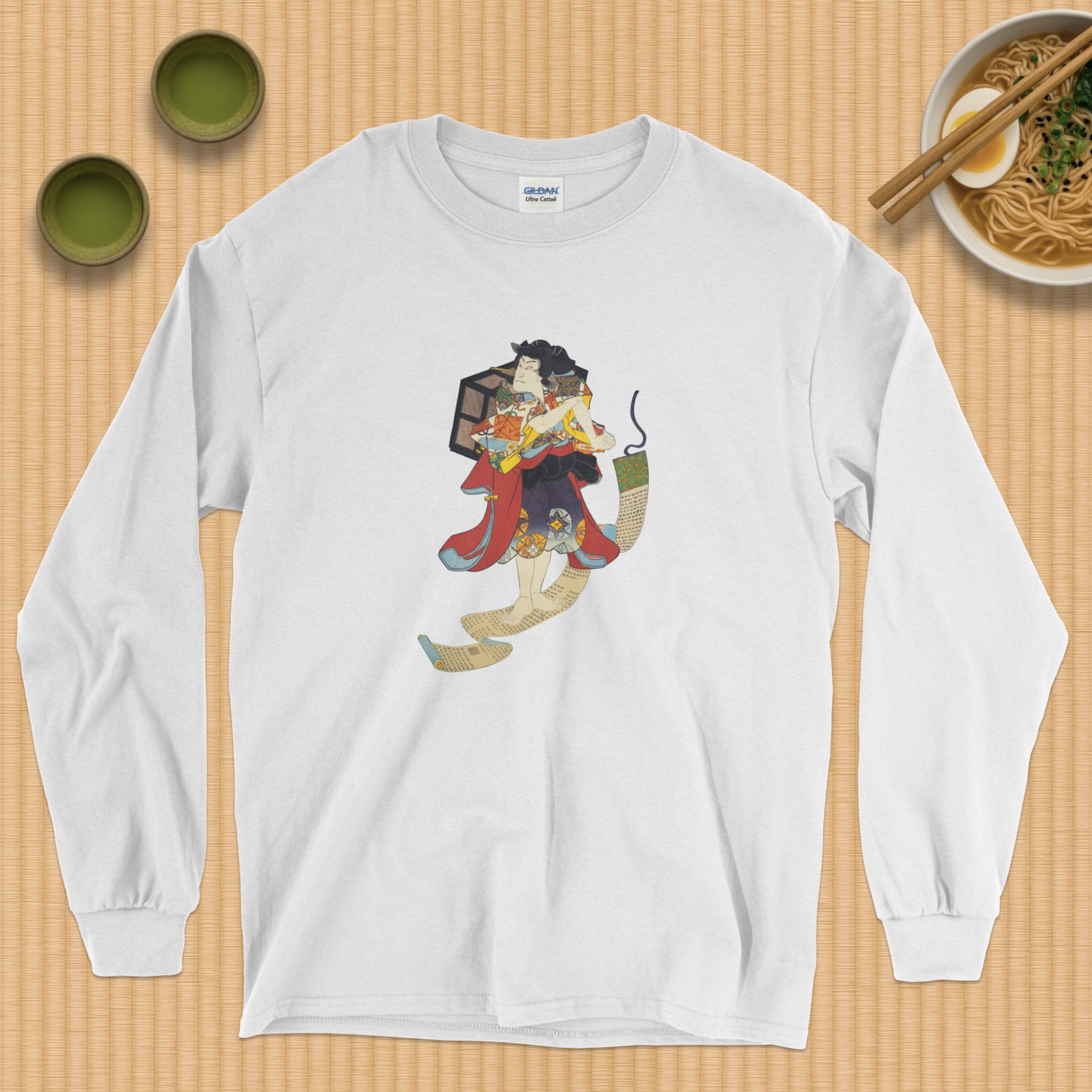
Here he's caught mid-escape, and mid-magic. Goemon rides an unfurled scroll through the empty air, one sleeve shoved up, a great wicker basket lashed to his back, glancing back over his shoulder with the easy insolence of a man who knows nobody can lay a hand on him while he's airborne — the scroll being the secret document of sorcerous arts that gives him his ninja-like powers. On stage this was no mere painted effect: the actor rose up through a trapdoor in the hanamichi walkway and flew out over the heads of the audience on hidden wires, a coup of pure theatrical showmanship that must have brought the house down. (That basket, in some tellings, hides a body — the thief's business rarely stays tidy.)
The hand behind it is Utagawa Kunisada, signing as Toyokuni III — the most prolific and commercially dominant print artist of the age, and the supreme portraitist of the kabuki stage. This comes from a run of supernatural showpieces in which he handed his favourite stars spells, swords and spectacle, and it stars Nakamura Shikan IV, one of the great actors of the day. As a prized first-edition impression it shows off every luxury of the printer's craft — blind-embossing pressed into the white sleeve, a lacquer-black sheen on the sash, and a second pattern ghosted over the red robe in barely-there shine.
The actor Nakamura Shikan (中村芝翫) as Sutewakamaru (捨若丸), from the series Toyokuni kigō kijutsu kurabe (豊国揮毫奇術競, A Contest of Magic Scenes by Toyokuni) 1864.
Utagawa Kunisada (歌川国貞, 1786-1865)